Essential Reading for Electrical Engineers
Polarized vs. Non-Polarized DC Circuit Breakers:In-Depth Analysis and Selection Guide
With the rapid growth of photovoltaic energy, energy storage systems, and electric vehicle charging infrastructure, direct-current (DC) distribution systems are becoming increasingly common in everyday life.
When designing or maintaining a DC circuit, one question often causes confusion for both beginners and experienced engineers:Should a polarized or non-polarized DC circuit breaker be used?
This article explains the fundamental differences between the two types and provides a clearselection guide based on typical real-world applications.
Polarized DC Circuit Breaker
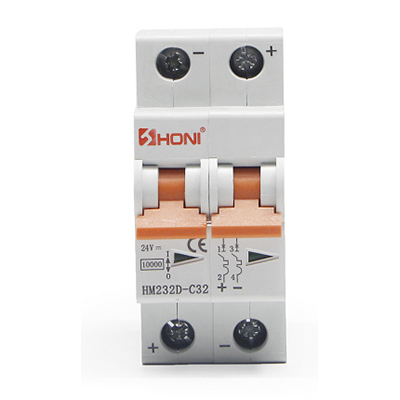
Current direction must follow the marked + / – polarity.
Non-Polarized DC Circuit Breaker
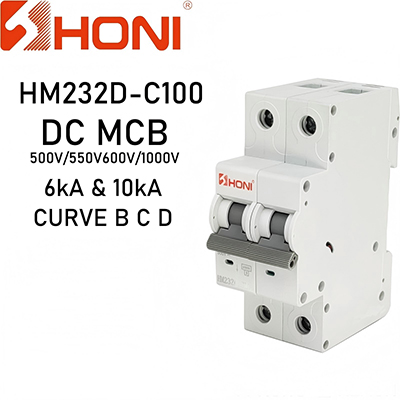
Designed to interrupt current safely in either direction.
Quick takeaway
Use a non-polarized DC circuit breaker whenever bidirectional current, reverse-current backfeeding, or uncertain wiring direction may occur. A polarized breaker is suitable only where current direction is fixed and installation polarity is strictly controlled.
1. The Fundamental Difference: Why Does Polarity Matter?
To understand the difference between polarized and non-polarized DC circuit breakers, we must first understand how arc extinction differs between alternating current and direct current.
In an alternating-current circuit, the current periodically changes direction and passes through a natural zero-crossing point during every cycle. This makes it relatively easy for an electrical arc to extinguish.
Direct current, however, has no natural zero-crossing point. Once a DC arc is established, it is much more difficult to interrupt.
To force the arc to move away from the contacts, DC circuit breakers commonly use permanent magnets. The magnetic field acts on the current-carrying arc through the Lorentz force, pushing the arc into the arc-extinguishing chamber, where it is lengthened, cooled, divided, and ultimately extinguished.
At a glance
| Comparison item | Polarized DC breaker | Non-polarized DC breaker |
|---|---|---|
| Arc-control design | Fixed magnetic-field direction | Bidirectional magnetic circuit or equivalent arc-control design |
| Current direction | Must follow the marked polarity | Can interrupt current flowing in either direction |
| Reverse-current condition | May drive the arc away from the arc chamber | Arc remains directed toward the arc chamber |
| Main advantage | Lower cost and compact construction | Greater flexibility, fault tolerance, and installation safety |
| Best suited to | Strictly unidirectional DC loads | PV, ESS, V2G, and other bidirectional or uncertain-current systems |
Why the arc behaves differently
AC CIRCUIT
Natural zero-crossing
The current periodically passes through zero, so the electrical arc has a natural opportunity to extinguish during every cycle.
DC CIRCUIT
No natural zero-crossing
Once the arc is established, magnetic force must drive it into the arc-extinguishing chamber so it can be lengthened, cooled, divided, and interrupted.
1.1 Polarized DC Circuit Breakers
Operating principle. A polarized DC circuit breaker contains permanent magnets with a fixed magnetic-field direction. Only when current flows through the breaker in the specified direction, according to the marked positive and negative terminals, will the resulting Lorentz force push the arc toward the arc-extinguishing chamber.
Critical risk
When the breaker is connected with reversed polarity – or when reverse current flows through the circuit – the direction of the Lorentz force is also reversed. Instead of being pushed into the arc-extinguishing chamber, the arc may be driven toward the breaker’s internal operating mechanism. As a result, the arc may fail to extinguish, causing the circuit breaker to burn out within a very short period of time. In severe cases, this may lead to fire or other catastrophic equipment failure.
1.2 Non-Polarized DC Circuit Breakers
Operating principle. A non-polarized DC circuit breaker uses a more sophisticated bidirectional arc-control design. This may include a symmetrical dual-permanent-magnet structure, a specially designed magnetic circuit, or an electromagnetic blowout coil.
Core advantage
Regardless of whether the current flows in the forward or reverse direction, the internal arc-control mechanism ensures that the arc is always directed toward the arc-extinguishing chamber. A non-polarized DC circuit breaker is therefore not restricted by current direction and can safely interrupt current flowing in either direction.
2. Typical Applications and Selection Logic
In practical electrical engineering and equipment procurement, selecting the wrong type of DC circuit breaker can result in costly equipment damage and serious safety risks. The following are some of the most common application scenarios.
Scenario 1: Photovoltaic Power Generation Systems
Practical concern
This includes rooftop solar systems and utility-scale ground-mounted photovoltaic power plants. Under normal daytime operating conditions, current generated by the photovoltaic modules generally flows in one direction. However, reverse current may occur at night, when modules are partially shaded, when one string in a multi-string system develops a short circuit, or when parallel strings feed fault current back into a faulty string.
Selection recommendation
A non-polarized DC circuit breaker should be selected. If reverse current occurs and a polarized circuit breaker trips while current is flowing in the opposite direction, the breaker may be unable to extinguish the arc correctly, potentially resulting in severe damage or catastrophic failure.
Scenario 2: DC Electric Vehicle Charging Stations
Practical concern
This includes fast-charging and ultra-fast-charging stations. Traditional DC charging stations transfer power in one direction, from the grid and charging equipment to the vehicle battery.
However, vehicle-to-grid (V2G) technology allows electric vehicles to discharge energy back into the grid. Reverse current may also occur under abnormal conditions, such as when the vehicle battery voltage becomes higher than the charging station output voltage.
Selection recommendation
A non-polarized DC circuit breaker should be given priority.
It supports future bidirectional charging upgrades and provides greater protection against reverse-current conditions. From both a safety and long-term commercial perspective, a non-polarized design is generally the more appropriate choice.
Scenario 3: Residential and Industrial Energy Storage Systems
Practical concern
The battery is the core component of an energy storage system. Its operating characteristics are inherently bidirectional: during charging, current flows into the battery; during discharging, current flows out of the battery.
Selection recommendation
A non-polarized DC circuit breaker must be used.
In the main circuit between the battery and the inverter, the current direction changes between charging and discharging modes. A polarized circuit breaker cannot reliably accommodate this bidirectional current flow.
Scenario 4: Conventional Unidirectional DC Loads
Practical concern
Examples include DC water pumps and certain DC power-distribution systems in data centers. The power-supply direction is fixed, the equipment is supplied by a centralized power module, and the downstream load has no possibility of generating or feeding current back into the source.
Selection recommendation
A polarized DC circuit breaker may be used.
In simple applications where the current direction is fully fixed and properly controlled, a polarized circuit breaker can offer lower manufacturing cost, smaller physical dimensions, and better cost-effectiveness. However, the installation polarity must be clearly marked and strictly observed.
Engineering note
When the system architecture may be upgraded later – for example, from unidirectional charging to V2G, or from a simple PV string to a hybrid PV-plus-storage system – selecting a non-polarized breaker from the outset can reduce redesign risk.
Do not describe this product as suitable for all applications. Application, RCD type and documentation scope must be confirmed before quotation.
Warning: Incorrect terminal tightening may cause overheating, loose connection, nuisance tripping or product malfunction. For EV, PV,heat pump, VFD, UPS or storage applications, confirm RCD type selection separately before installation.
3. One-Minute Selection Rule
When evaluating a DC circuit application, the correct breaker type can usually be selected by answering two questions.
QUESTION 1
Is there any possibility of bidirectional current flow or reverse-current backfeeding in the circuit?
YES -> Select a non-polarized DC circuit breaker without hesitation.
NO -> Proceed to Question 2.
QUESTION 2
Can the installer guarantee that the breaker will never be connected with reversed polarity, and is the project extremely cost-sensitive?
YES -> A polarized DC circuit breaker may be considered, provided that the positive and negative terminals are clearly marked and installation controls are strictly implemented.
NO OR UNCERTAIN -> Upgrade to a non-polarized DC circuit breaker to provide an additional safety margin.
Conclusion
In the electrical industry, safety must always come first.
As the cost of non-polarized arc-extinguishing technology continues to decrease, non-polarized DC circuit breakers are becoming increasingly common across modern DC distribution systems.
For photovoltaic installations, energy storage systems, bidirectional EV charging equipment, and other applications where current direction may change, non-polarized DC circuit breakers provide greater installation flexibility, stronger fault tolerance, and a higher level of safety
Final recommendation
The transition toward non-polarized DC protection has become a clear development trend in modern DC power-distribution systems. Use polarized breakers only where current direction is fixed, verified, and permanently controlled.